The patent describes this dynamic compiler as follows: the dynamic compiler comprises three stages: (1) a decoding stage for decoding the source instructions and parameters, creating an instruction stream that is optimized based on the source instructions and parameters; (2) an optimization stage for optimizing the flow of information and related operation code based on the characteristics of the target processor; and (3) an encoding stage for encoding instructions specifically for the target processor to achieve the intended results, including further optimizing the operation code for the target processor. For purpose of illustrating the inventive concept, the present invention is described using the example of recompilation of video game software for playing on a personal computer system.
Sony's dynamic recompilation process
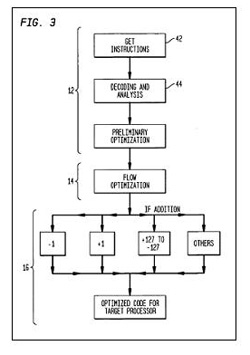
FIG. 3 is a schematic flow diagram of the dynamic recompilation process in accordance with one embodiment of the present invention.
"Referring to FIG. 3, at the decoding stage 12, the source instructions are fetched at 40, e.g. from a CD-ROM read by a CD-ROM drive, a hard drive,or in real time streamed over a network. The instructions are analyzed and decoded at 42 in blocks of varying sizes that depend on several factors, such as the location of the instruction and data in memory or register, the available system resource (e.g., registers, memory), timing, instruction sequences based on functionality of the instructions (e.g., entry point), target processor's operational characteristics. In essence, the purpose of the instructions and flow of information (e.g., where data comes from and going to) are determined at 42. The decoding stage goes through the block of source instructions and analyzes, examines the operation codes, and outputs an instruction string which is basically a breakdown of what the functional operations are doing. For example for addition, it determines what is the addition from, which two numbers are being added, where the numbers come from, and where to put the result of the addition when done. The instruction string output stream contains information on the flow of information in the program."
Applies to X86 and PowerPC
Elsewhere in the patent it states that "the present invention is described herein-below in reference to examples of deployments and implementations for translating software written for a proprietary game player for playing on a personal computer." Specifically, the new compiler will work on targeted platforms such as Motorola's PowerPC and Intel's 80X86 - for game, business, productivity and other types of application software. It will also apply to real-time streaming over a network.
Interestingly, the patent references Sony's old proprietary CD format for games being restrictive - and the distinct impression that I'm left with is that Sony's new dynamic compiler will somehow be integrated into [url=http://www.sonypictures.com/homevideo/bluray/]Blu-ray[/url], though this marketing trademark is never once mentioned by name (which is typical of patents).
The big question
The big question that can't be answered by this patent is perhaps the most important. That is, being that the system is described in such a manner that a PowerPC system will be able to run CD's written for an Intel based system and vice versa, will their "dynamic compiler" be restricted to Sony based Systems? Meaning - is their new emulation scheme simply designed to allow Sony desktop and notebooks to run Playstation games and Intel productivity software to run on the PlayStation – or – will Sony be opening up their PlayStation games to be run on any PC systems such as Intel Macs?
Being that [url=http://www.apple.com/pr/library/2005/mar/10blu-ray.html]Apple joined the Blu-ray Disc Association board[/url] on March 10, 2005; you have to wonder if Apple and Sony could come to some sort of an agreement on video games that would benefit both parties. Back in [url=http://www.macsimumnews.com/index.php/archive/is_apple_still_working_with_sony_on_a_next_wave_home_theater_audio_system_b]March[/url] I posted a report which included a photo of Steve Jobs with a Sony Bravia HDTV being prominently displayed in one of his slides. Again in March, I posted another [url=http://www.macsimumnews.com/index.php/archive/apple_intels_idf_and_getting_personal/]report[/url] that touched on Intel’s truly amazing Conroe gaming demo that reached speeds of 111 frames per second (fps). By combining Conroe with Sony’s advanced emulator and a top line Nvidia graphics card – Apple’s Intel Mac would be one stunning gaming platform in time for this Christmas. Sony on the other hand would like nothing more than to be able to penetrate the PC market with PlayStation games in order to strike back at Microsoft in their own back yard.
Unfortunately patents don't get involved with marketing plans and so we'll just have to wait and see how this all plays out in the future.
If you have an opinion on this, then {encode=neo@macsimumnews.com title=Email Neo}
Notice
Macsimum News presents only a brief summary of patents with associated graphic(s) for journalistic news purposes as each such patent application and/or grant is revealed by the U.S. Patent & Trade Office. Readers are cautioned that the full text of any patent applications and/or grants should be read in its entirety for further details.










