The present invention meets these needs by allowing instant messaging applications to track and share identity-based activity and active content of a user with the user's contacts. Advantageously, the present invention provides an enhanced communication experience between a user and remote contacts that includes entertainment and online activities.
In one embodiment, a system comprises a content [url=http://en.wikipedia.org/wiki/Daemon_%28computer_software%29]daemon[/url] on a sender peer to track active content of a user and identity-based activity. Active content includes files that a user is currently accessing, such as music files the user is currently listening to, movies the user is currently watching, and the like. Identity-based activity includes broader activities of a specific user, such as web-based auctions posted by or transactions conducted by a user logged-in to a chat module, and active content previously viewed by the user. The Chat module shares identity-based activity with a remotely located recipient peer through a network by sending information collected by the content daemon. The recipient chat module displays identity-based activity and/or related information to the contact.
In another embodiment, the contact daemon tracks user activity by, e.g., polling application modules for current active content and identity-based activity, and storing the information in a list kept by a content information database. The application module comprises a media player, a web browser, or other application for activating content and/or performing user activities. The list includes, for example, the last five audio files listened to by the user, recent downloads, an online auction or transaction conducted by the user, etc. In one embodiment, the list is populated with unique identifiers. For active content, an exemplary unique identifier is an ID3 tag for MP3s; and for identity-based activity, an exemplary unique identifier identifies a specific user's auction with e.g., a URL or a key. In another embodiment, the content daemon detects identity-based activity in an application module that is in communication with an active server. The activity server hosts online user activities such as online auctions or transactions. In response, the contact daemon records the unique identifier associated with the identity-based activity.
In yet another embodiment, a content enhanced server includes a content supplement database to provide supplements to identity-based activity information to the recipient peer. Supplemental information can include descriptive information about the content, meta-data, or additional information, such as name, creator, content descriptions, related files and so forth ( e.g., a CD containing the active media, a graphic file of the artist, a preview, or transactional information to obtain a copy). In another embodiment, the content supplement database stores previews of content for streaming to the recipient peer. The content enhancement server also includes a content transaction module to enable a transaction based on the shared content information. The content enhancement server, for example, enables a purchase a copy of a shared music file. In another embodiment, the content transaction module serves as a gateway to third-party databases with available products by using application program interfaces to search the third-party databases and generate a list of available products.
Various related user interfaces
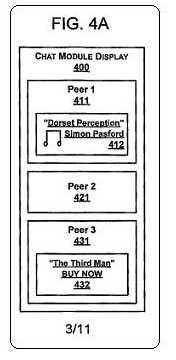
Patent Figure 4A is an illustration of a user interface displaying a recipient peer's chat module 400 with integrated active content information according to one embodiment of the present invention. One of ordinary skill of the art will recognize that Figures 4A - 4C are merely illustrative examples and that there are many variations with the scope of the invention. The chat module display 400 comprises contacts 411, 421, 431 which are other peers on the network and if there is any, each contact's active information 412, 422. The contacts are a list of peers, which may be personal contacts, co-works, or any other peers on the network 145.
A music icon indicates that the user of Peer 1 is listening to a song, which in this example is "Dorset Perception" by Simon Pasford. In response to selecting the icon, the chat module 210 may initiate an active content stream, enable a purchase, retrieve content supplements, etc. In one embodiment,, response to selecting a hyperlink associated with the song title or artist, a list of similar songs, or other songs by the artist is returned.
The representation of Peer 2 does not include information about active content at Peer 2. In one embodiment, Peer 2 does not sent information about active content because, for example, there is no currently active content at Peer 2 or because Peer 2 has not is configured to share active content with the recipient peer 120. In another embodiment, the chat module 210 does not display received active content information because, for example, the recipient peer 120 is not capable of receiving an active content stream, or not capable of activating streamed content.
The representation of Peer 3 includes an icon indicating that the active content 432 at Peer 3 is a movie titled "The Third Man," and that this movie is available for purchase. In response to selecting the icon, the chat module 210 enables a transaction.
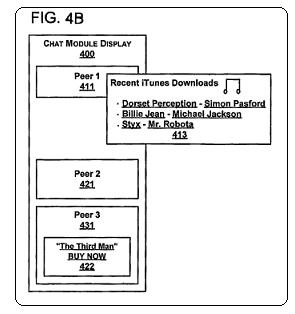
Patent Figure 4B is an illustration of a user interface displaying a recipient peer's chat module 400 with integrated identity-based activity according to one of the embodiment of the present invention. The identity-based activity of this example comprises recently downloaded songs form iTunes. In one embodiment, activating the song hyperlink initiates a transaction such as a purchase of the song from iTunes. In another embodiment, activating the artist hyperlink returns a list of other MP3s by the artist.
Patent Figure 4C is an illustration of a user interface 450 displaying a recipient peer's application module with an integrated module with an integrated chat module. The user interface includes an application module display 470 and a chat module display 460. The user interface may be rendered by a GUI to display an application module 230.
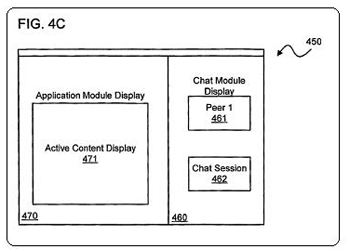
The application module display 470 further includes an active content display 471 to output the content currently available to a peer. For example, the display can show active video content in response to that same content being displayed on the sender peer's 110 active content display.
The chat module display 460 further includes a representation of Peer 1 and a chat session 462. Peer 1 is preferably a peer having active content compatible with the application module 230. The chat session 462 is disposed within the user interface to allow access to messaging while viewing active content. Advantageously, the peer user need not toggle between application windows when messaging a peer about shared active content.
Notice
Macsimum News presents only a brief summary of patents with associated graphic(s) for journalistic news purposes as each such patent application and/or grant is revealed by the U.S. Patent & Trade Office. Readers are cautioned that the full text of any patent applications and/or grants should be read in its entirety for further details.
Neo's Notes
If you wish to see patent figures 6-11 that illustrate various related flowcharts or "sequence diagrams," see [url=http://www.macsimumnews.com/index.php/archive/part_2_apples_eu_patent_flowcharts_for_peer_to_peer_content_sharing/]"Part 2: Apple's EU Patent Flowcharts for "Peer-to-Peer Content Sharing."[/url]
For general interest, the patent does state that in one embodiment, the OS could either be OS X or Windows XP, though they never reveal which embodiment that is. The reason that this could potentially be interesting is that so much of this patent integrates iChat, which of course isn't available for Window XP users, today. However, in context, the patent does refers to "The application module comprises a media player, a web browser, or other application for activating content and/or performing user activities." The "web browser," in one point in the patent describes it as downloading web pages, so it's not iTMS, in my opinion, which is also considered to be a form of browser, but rather a web browser that would definitely include Safari. That would be the news of the day if that would ever surface. That just so happens to be a topic that a I recently covered in a report titled [url=http://www.macsimumnews.com/index.php/archive/analysis_if_leopard_will_run_windows_xp_natively_will_linux_be_next/]"If 'Leopard' will run Windows XP natively, will Linux be next?"[/url] In that report I discuss the possibility of Apple releasing the Safari web browser for Window users, in or around the time of OS X Leopard's official launch.
Do I have my fingers crossed? Yes. But the patent doesn't give you much to work with here, so I'll have to leave it as "interesting," for now. Yet there's no doubt that the patent is describing a unique combination application which includes a web browser.
Lastly, the patent, without a doubt makes reference to "book," "books," and separately "audible e-books" which may be a nice heads-up pointing to Apple's intentions of entering the e-book business on iTMS, beyond just audible e-books. Hmm, keep your eye open for a new report on that very subject later today.
If you have an opinion on this patent report, email me at neo@macsimumnews.com
Other miscellaneous patent figures
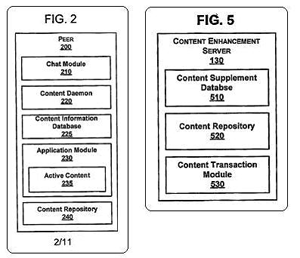
Patent Figure 2 is a block diagram illustrating a peer according to one embodiment of the present invention.
Patent Figure 5 is a block diagram illustrating the content enhancement server according to an embodiment of the present invention.