The principal components of electronic ink are millions of tiny microcapsules, about the diameter of a human hair. In one incarnation, each microcapsule contains positively charged white particles and negatively charged black particles suspended in a clear fluid. When a negative electric field is applied, the white particles move to the top of the microcapsule where they become visible to the user. This makes the surface appear white at that spot. At the same time, an opposite electric field pulls the black particles to the bottom of the microcapsules where they are hidden. By reversing this process, the black particles appear at the top of the capsule, which now makes the surface appear dark at that spot.
To form an E Ink electronic display, the ink is printed onto a sheet of plastic film that is laminated to a layer of circuitry. The circuitry forms a pattern of pixels that can then be controlled by a display driver. These microcapsules are suspended in a liquid "carrier medium" allowing them to be printed using existing screen printing processes onto virtually any surface, including glass, plastic, fabric and even paper.
E Ink's electronic ink is an image stable reflective display technology that uses low power but can be read under any lighting condition -- including direct sunlight. Unlike liquid crystal displays, the image on E Ink displays looks the same from all viewing angles and won't distort when touched or flexed, making electronic ink the ideal display medium for flexible displays and portable devices, according to the folks at E Ink.
E Ink currently offers all-plastic segmented cells that are flexible and comformable. These cells can be used in a range of applications from clocks and watches to electronic shelf displays and preprogrammed signage. While E Ink's display materials already enable fully flexible displays, flexible backplane technology for high-resolution, active matrix displays are in the development stage. Once these backplanes are widely available to display manufacturers we can expect to see the adoption of flexible displays in a number of applications requiring high resolution.
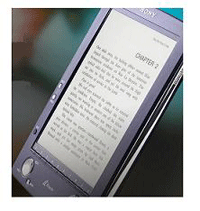
This spring Sony will debut the US$400 Sony Portable Reader (shown), which uses E Ink and closely mimics the size, weight, and feel of a book. Sony also will offer roughly 10,000 book titles for download from its online store, along with news stories and blog items. It has a six-inch "electronic display" with SVGA 800x600 resolutions (approximately 170 pixels per inch).
However, it may take Apple to come up with a digital book reader -- or iPod add-on -- that really works with digital books. The Sony Portable Reader hasn't gotten great pre-release buzz.
Dan Farber, writing for [url=http://blogs.zdnet.com/BTL/?p=2619]ZDNet[/url], has this to say: "Isn't it totally obvious that compared to buying a book, which is utterly portable, requires no batteries, has a well-defined user interface, and comes equipped to be understood by most pairs of eyes, buying a crippled digital player that can only handle one kind of media -- and can't even surf the Web in 2006 -- is a stupid idea. Add the fact that you can only buy books that publishers have translated into Sony's format, running the gauntlet of the company's own hated Digital Rights Management software, and that they cost almost as much as the book anyway, and you have to wonder what is in the sushi they serve at Sony's headquarters. For about the same price as one of these "readers," I can buy a PDA that has few limitations, will surf the Web and let me send email, is about the same size, and can already display books to boot."
With its iPod, Apple has demonstrated that millions of people are willing to carry around digital devices with their favorite content," Business Week Online says, adding "After music, why not novels and nonfiction?"
That day is coming, I'm sure. It's just a question of who gets it right first. And I wouldn't bet against Apple.
Thoughts? Write me at dsellers@macsimumnews.com










