QuickTime format adopted
The following is only one block of excerpts from the Sharp patent:
As a format for the AV stream management, QuickTime file format is adopted. The QuickTime file format is used for managing multimedia data, and has been developed by Apple Computer Inc. This format is popularly used in the field of PC.
The QuickTime file formant is made up of (i) video data, audio data, or the like (these types of data are collectively termed "media data") and (ii) management information. The media data and management information are collectively termed "QuickTime movie" (or simply "movie"). The media data and management information may be in a single file or may be in different files.
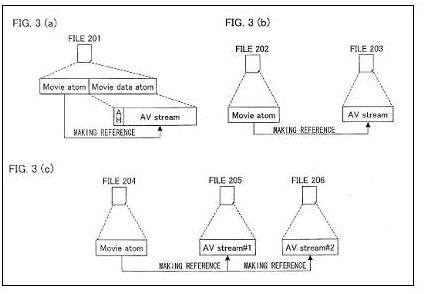 If the media data and management information exist in the same file, the file is configured as shown in FIG. 3(a). Various types of information are uniformly stored in the form of "atom.†In a file 201, the management information is stored in "Media atom,†and an AV stream of media data is stored in "Movie data atom.â€At the head of a Movie data atom, Atom header (AH) is provided. It is noted that the management information in a Movie atom includes, for instance, (i) a table for working out a relative position, in a file, of an AV stream corresponding to a particular period of time in media data, (ii) attribute information of media data, and (iii) external reference information which will be described later.
On the other hand, if the management information and media data are stored in different files, the arrangement shown in FIG. 3(b) is adopted. In this case, the management information in a file 202 is stored in a Movie atom. Meanwhile, it is unnecessary to store an AV stream in an atom, and hence the AV stream is stored in a file 203. Such a case is expressed as the Movie atom "externally refers to" the file 203 storing the AV stream.
In case of the external reference, as shown in FIG. 3(c), one file 204 that stores the management information can refer to a plurality of AV stream files (files 205 and 206 in the figure). This structure allows the nonlinear editing or nondestructive editing which makes it possible to apparently perform the editing without physically moving the AV stream. The structure also makes it possible to generate a plurality of user programs using identical scenes of AV streams recorded on the optical disc 106, and further allows a plurality of user programs to refer to a single set of post recording data.
What is QuickTime Atom?
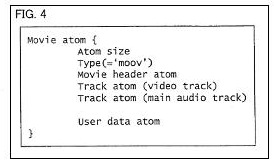
Referring to Patent FIGS. 4-14, the format of the management information in QuickTime will be described. First, what is "atom,â€, which is a common information storage format, is described. An atom always starts with "Atom size" indicating the size of the atom, and "Type" indicating the type of the atom. Type is made up of four letters, e.g. `moov` is Type of Movie atom, and `mdat` is Type of Movie data atom.
Atoms are hierarchically structured, so that an atom may include another atom. A structure of a Movie atom is illustrated in FIG. 4. Movie header atom manages the overall attribute of a movie managed by the Movie atom. Track atom stores information relating to tracks of video, audio or the like, which are included in the movie. User data atom can be arbitrarily defined by the user.
Forms of Atoms
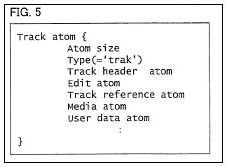
A structure of the Track atom is illustrated in patent FIG. 5. Track header atom manages the overall attribute of a track. Edit atom indicates which section of the media data is played back at what timing in the movie. Track reference atom manages the relationship with another track. Media atom manages actual video data, audio data, and the like.
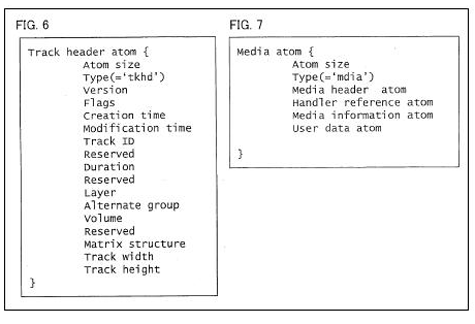
A structure of the Track header atom is illustrated in patent FIG. 6 (below). Note that this paragraph only explains the elements necessary in the later explanations. Flags is a group of flags indicating attributes. A representative one of Flags is Track enabled flag. If this flag is `1`, the track associated with the flag is played back. If the flag is `0`, the track is not played back. Track ID is an ID unique to each track. Layer indicates a spatial priority of the track. If there are a plurality of tracks for displaying images, an image of the track with the smallest Layer is displayed at the forefront.
A structure of Media atom is illustrated in patent FIG. 7. Media header atom manages the overall attribute or the like in regard of media data managed by the Media atom. Handler reference atom stores information indicating by which decoder the media data is decoded. Media information atom manages attribute information inherent to the media, e.g. video and audio.
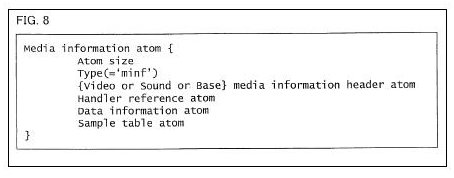
A structure of the Media information atom is illustrated in patent FIG. 8. Media information header atom manages attribute information inherent to the media, e.g. video and audio. Handler reference atom is identical with that in the Media atom. Data information atom includes Data reference atom that manages the name of a file including the media data being referred to by the associated QuickTime movie. Sample table atom manages the size of data, playback time, and the like.
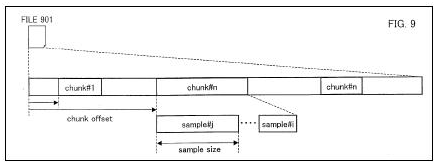
Before describing Sample table atom, how data is managed in QuickTime is described in reference to patent FIG. 9. In QuickTime, the minimum unit (e.g. video frame) of data is termed "sample". In each track, samples have the numbers (sample numbers) which start from 1 and correspond to the order of playback.
Also, according to the QuickTime format, the playback time length and data size of each sample are managed. In the file, there are areas in which samples belonging to the same track are serially disposed in line with the order of playback. Such an area is termed "chunk". Chunks also have the numbers that starts from 1, in accordance with the order of playback. In short, according to the QuickTime format, a file 901 is composed by serially disposing the chunks.
According to the QuickTime format, the followings are managed: (i) an address, of each chunk, from the top-of-file, and (ii) the number of samples included in each chunk. With these types of information, it is possible to locate the sample corresponding to a particular time.
A structure of sample table atom is illustrated in patent FIG. 10. Sample description atom manages, for example, Data Format of each chunk and an index of the chunk in a file, in which chunk the associated sample is stored. A structure of Sample description table is illustrated in FIG. 11(a). In the figure, number-of-entries indicates the number of data formats that are used, and the number of existing Sample description table corresponds to the number-of-entries. FIG. 11(b) shows an example of audio Sample description table.
In Sample table atom shown in patent FIG. 10, Time-to-sample atom manages the playback time of each sample. Sync sample atom manages, among samples, which sample is readily decodable. Sample-to-chunk atom manages the number of samples in each chunk. Sample size atom manages the size of each sample. Chunk offset atom manages an address, of each chunk, from the top-of-file.
As shown in patent FIG. 12, Edit atom includes one Edit list atom. The Edit list atom has groups (entries) each including Track duration, Media time, and Media rate. The number of the entries in the Edit list atom is specified by Number of entries. Each entry corresponds to a section where, on the track, samples are played back in sequence. The entries are disposed in line with the order of playback on the track.
Track duration indicates how long, on the track, the section managed by the entry is played back. Media time indicates that position on the media data which corresponds to the head of the section managed by the entry. Media rate indicates the playback speed in the section managed by the entry. If Media time is `-1`, the playback of the sample in the track is stopped for a time period corresponding to the Track duration of the entry. This time period is termed "empty edit.â€
Patent FIG. 13 [at the top of this report] shows an example of how Edit list is used. In the example, the content of Edit list atom is as shown in FIG. 13(a), and the configuration of the sample is as shown in FIG. 13(b). Also, in the example, Track duration of an " i-th entry" is indicated as D(i), Media time thereof is indicated as T(i), and Media rate thereof is indicated as R(i). The playback of the sample is actually performed in the order shown in FIG. 13(c). This will be briefly described below.
First, in the entry #1, Track duration is 13000, Media time is 20000, and Media rate is 1. Therefore, from the head of the track to 13000, the sections with the times from 20000 to 30000 in the sample are played back. Then, in the entry #2, Track duration is 5000 and Media time is -1. Therefore, no playback is performed during the sections with the times from 13000 to 18000 in the track. In the entry #3, Track duration is 10000, Media time is 0, and Media rate is 1. Therefore, during the sections with the times from 18000 to 28000 in the track, the sections with the times from 0 to 10000 in the sample are played back.
Patent FIG. 14 shows the configuration of User data atom. This atom can store an arbitrary number of pieces of original information not defined in the QuickTime format. One piece of original information is managed by one entry. One entry is composed of Atom size, Type, and User data. Atom size indicates the size of the entry, Type indicates identification information for differentiation between the pieces of the original information, and User data indicates the actual data.
Index file
In order to manage the QuickTime movies in the disc, one special QuickTime movie file which is termed "index file" is provided in the disc.
What are registered in the index file are thumbnails and various types of attributes in regard of files in the disc (files are, for instance, QuickTime movies and still images referred to by the QuickTime movies). The attributes include "link count" that indicates how many times the file is externally referred to.
Referring to the link count makes it possible to easily recognize if there is another file referring to the file or not. Therefore, it is possible to prevent the file, which is referred to by another file, from being mistakenly deleted.
Details of one system configuration
The following is a detailed description of one embodiment configuration that will utilize Apple's QuickTime Atom technology:
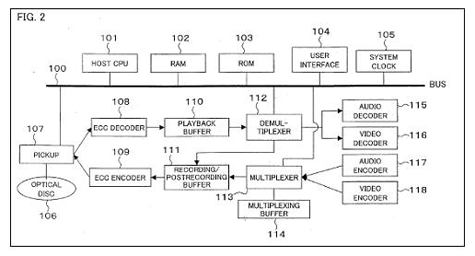
Patent FIG. 2 shows a post-recordable video disc recorder that is commonly used in the embodiments.
As shown in the figure, the video disc recorder includes: a bus 100; host CPU (Central Processing Unit) 101; RAM (Random Access Memory) 102; ROM (Read Only Memory) 103; user interface 104; system clock 105; optical disc 106; pickup 107; ECC (Error Correcting Code) decoder 108; ECC encoder 109; playback buffer 110; recording/postrecording buffer 111; demultiplexer 112; multiplexer 113; multiplexing buffer 114; audio decoder 115; video decoder 116; audio encode 117; and video encoder 118. In addition to them, the video disc recorder further includes a camera, microphone, speaker, display, and the like, which are not illustrated in the figure.
The host CPU 101 communicates with, via the bus 100, the demultiplexer 112, multiplexer 113, and the pickup 107. Although not being illustrated, the host CPU 101 also communicates with, via the bus 100, the audio decoder 115, video decoder 116, audio encoder 117, and video encoder 118.
To perform the playback, the data read out from the optical disc 106 using the pickup 107 is subjected to error correction in the ECC decoder 108, and is then temporarily stored in the playback buffer 110. In response to a data transmission request from the audio decoder 115 or video decoder 116, the demultiplexer 112 accordingly sends the data in the playback buffer 110 to a decoder suitable for the type of the data.
To perform the recording, the data compressed and encoded by the audio encoder 117 and video encoder 118 is supplied to the multiplexing buffer 114 via the multiplexer 113. The data is further AV-multiplexed by the multiplexer 113 and then supplied from the multiplexing buffer 114 to the recording/postrecording buffer 111. To the data in the recording/postrecording buffer 111, an error correction code is added by the ECC encoder 109. The data is then recorded onto the optical disc 106, using the pickup 107.
The patent does detail two embodiments which use QuickTime and both include patent subject headers: Processing in Initial Recording, Processing in Recording of Postrecording Data, Processing in Generating User Program, and Processing in Deletion of User Program.
Additional patent illustrations
Notice
Macsimum News presents only a brief summary of patents with associated graphic(s) for journalistic news purposes as each such patent application and/or grant is revealed by the U.S. Patent & Trade Office. Readers are cautioned that the full text of any patent applications and/or grants should be read in its entirety for further details.
Neo's note

Sharp Electronics has a great line up of HDTV's like AQUOS (see [url=http://www.sharpusa.com/files/tel_dow_AQUOS_Full_Line_0206.pdf]PDF[/url]). Their online TV guide, in respect to recording programs states:
Set recordings: AQUOS LC-TVs that feature TV Guide On Screen allow you to control a VCR, 1394/Fire Wire connected DVD recorder or hard drive. Just select a show and press the record button on the remote control. That's it, you're recording!
This patent covers a next generation recording device that will likely be used with AQUOS using QuickTime. Hmm, Apple's OS X uses the Aqua interface, and Sharp's top line HDTV is called AQU…OS. Hmm, that's an interesting coincidence. For now, it's great to see a giant Consumer Electronics company adopting QuickTime – and who knows just how far this relationship between Apple and Sharp may go.
If you have any comments regarding this patent report, email me at neo@macsimumnews.com or macsimum@shaw.ca - attention Neo.
One last thing
Just a simple observation about Apple's continuing evolutionary theme. Apple introduced "carbon," wherein Steve Jobs framed it as where all life begins (hmm – like iLife). In fact, according to [url=http://en.wikipedia.org/wiki/Carbon_(API)]Wikipedia[/url], the Carbon project at Apple was developed from the Quicktime for Windows codebase which has included a substantial subset of the classic Mac OS APIs since the early 1990s. QuickTime was one of the first Apple software components ported to the Rhapsody operating system as it was designed to be portable. Then there was Darwin, Apple's open source version of OS X. Now we read about QuickTime Atom in this patent. The Atom is also a part of Apple's Genius Bar logo.
Cheers!










