In its filing, Apple says that, conventionally, computer components, such as those of "desktop" computers, are disposed within an exterior housing such that various PC boards (PCBs) are stacked one over the other in a generally horizontal manner within the housing. Depending on the system requirements and specifications, heat generation and EMI (electromagnetic interference) are controlled using for example suitable conductive shields. Further, electric fans are used to dissipate heat from sensitive components. Apple says the fans take up valuable space within the housing, increase costs and noise, and are particularly susceptible to failure due to their mechanical nature. The fans and heat sink also complicate the general layout of the components within the housing, hampering access to PCBs that may need to be repaired or replaced, for example during an upgrade of the computer. To resolve these problems, conventional arrangements have relied on a less compact layout, such that components, while taking up more space than necessary, at least remain accessible for purposes of an upgrade for example. Of course, this comes with the expense of increased size and inefficiency.
Here's Apple's summary of the invention: "In accordance with the invention, an arrangement for a computer having a plurality of circuit boards, a heat sink, a hard disk drive, and one or more memory storage devices comprises a housing defining an interior compartment including first, second and third parallelepiped portions. The first, second and third parallelepiped portions accommodate, respectively, the plurality of circuit boards, the heat sink, and the one or more memory storage devices.
"Further in accordance with the invention, a desktop computer is provided with a housing having a plurality of sides defining a compartment therein, a frame removably mounted in said compartment, a replaceable computer component slidably mounted to said frame, and a hinged door having an open position and a closed position. In the closed position, the hinged door prevents access to the replaceable computer component, while in the open position the hinged door permits access to the replaceable computer component such that replacement of the replaceable computer component can be effected when the hinged door is in the open position.
"Further in accordance with the invention, a desktop computer assembly is provided which comprises a housing having four sides and first and second ends, the first and second ends being rigidly mounted to one another and being slidably detachable from the four sides. A frame which is rigidly mounted relative to the first and second ends is also provided, and a computer component is slidingly mounted in the frame. A door is mounted in a stationary position relative to the first and second ends but is movable between an open position and a closed position, the door in the open position providing access to the computer component such that movable component can be slidingly removed from the frame."
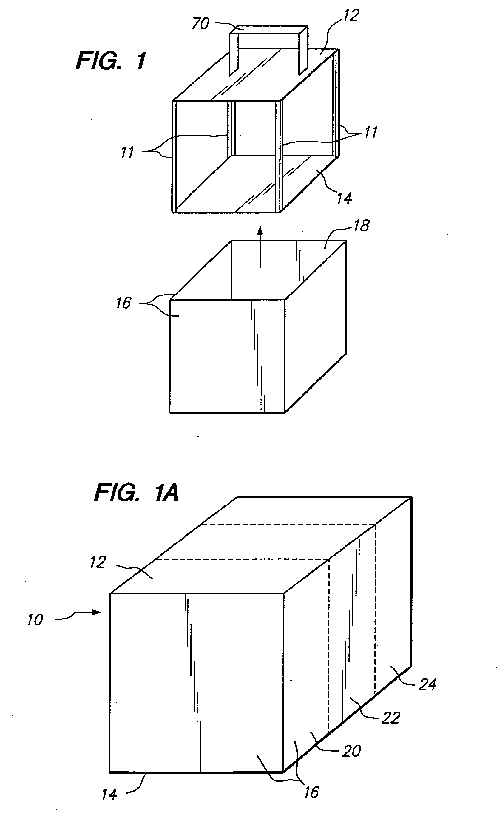
FIG. 1 is a perspective view of the housing in accordance with the invention. FIG. 1A is a schematic view of the portions of the interior of the housing in accordance with the invention;
The inventors are listed as Wayne H. Miller, Ricardo Alba Mariano and Steve Thomas.










