Detailed description
Described herein are mechanisms to provide functionality that allows a computer system (or other electronic device) to automatically utilize an appropriate network connection (e.g., VPN, PPP) when an application requests access to a network resource. In one embodiment, the appropriate network connection is determined based on contextual information provided by the application. For example, using a point-to-point protocol (PPP) connection (e.g., modem, PPPoE), typing a Universal Resource Locator (URL) in a Web browser should result in an automatic network connection.
For a Virtual Private Network (VPN) connection, the selection of network connection may be more complex. For example, typing a public URL (e.g., www.apple.com) may not result in utilization of a VPN connection, while typing a private URL (e.g., private.apple.com) may result in utilization of a VPN connection for authorized users. Utilization of the VPN connection for the public URL would result in authentication steps that may be distracting to a user or unnecessarily time consuming.
One mechanism for providing a network connection on demand is to provide a PPP connection each time an application attempts to send traffic to the network. When traffic arrives at the PPP networking layer, the system may not have enough information related to the context of the request in order to trigger the appropriate network connection. As a default, the system may attempt a connection for any traffic request. This is illustrated in the following example using an electronic mail application (hereinafter "mail application" for brevity).
A typical mail application may attempt to fetch new electronic mail in response to an explicit user request or as a background operation that occurs at predetermined time intervals. Fetching new electronic mail may include resolving a mail server address and making contact with the server. When such network traffic arrives in the networking stack, there is no way to effectively distinguish between a background fetch and a user initiated fetch. Both may be considered an application request that triggers a network connection. However, from a user perspective, these two functions are very distinct.
For the background fetch operation, the user may not be aware of the initiation of the fetch operation. The user may not be available to enter a password, if necessary. For the user initiated fetch operation, the user generally expects the fetch operation to occur. In addition when the application attempts a background fetch operation, the user may cancel the attempt. However, canceling one background fetch operation may not function to cancel subsequent background fetch operations. These subsequent background fetch operations may be distracting to the user.
An alternative mechanism may be to enable applications to provide contextual information along with a network access request. The contextual information may be used by system level components to determine what type of network connection should be triggered, if any. In this mechanism, the application is not required to determine the type of network connection to be triggered and the call may be made synchronously or asynchronously. The contextual information may be any type of contextual information, for example a flag indicating "connection mandatory" or "connection optional," or may be more complex. Thus, the applications making the network calls are not required to include evaluation capability to determine the type of network connection to be triggered.
The mechanisms described herein are generally described with respect to the Macintosh OS X environment; however, these mechanisms may also be applied to other operating systems, for example, Windows, UNIX or LINUX. By way of background, the Mac OS X environment may be conceptualized by the layers illustrated in FIG. 1. User experience layer 100 is an abstraction for methodologies for creating applications. Each methodology may be a set of guidelines and/of recommended technologies. Other operating systems may have similar conceptual layers.
Application environments layer 120 represents basic technologies for building applications. Application environment layer 120 may provide tools to developers for developing applications. Graphics and multimedia layer 125 may provide services for rendering two-dimensional and/or three-dimensional graphics, audio and/or video outputs. Application services layer 130 may provide features suited for applications rather than other types of software, for example, HTML rendering, font management, speech recognition, etc.
Core services layer 140 may implement low-level features that may be used by most types of software, for example, data formatting, memory management, process management, and/or low-level network communications. In one embodiment, many of the features of core services layer 140 may be included in the Core Foundation layer, which may be composed of several frameworks within OSX of Apple Computer. Alternatively, in a Windows operating system environment, similar functionality may be provided by sockets, which are known in the art. Core OS layer 160 may include the kernel, device drivers and/or low-level commands of the operating system environment.
In general, the Core Foundation framework enables sharing of code and data among various frameworks and libraries and may enable some degree of operating system independence. In one embodiment the Core Foundation framework may provide common APIs and other structures including, for example, a plug-in architecture, XML property lists and/or preferences.
In one embodiment, the Core Foundation framework may include a network connection API that allows an application to trigger a network connection. In one embodiment, the Core Foundation framework may send network traffic to available network connections and may not trigger a new network connection (e.g., a VPN connection). Thus, the Core Foundation framework may use a network connection that is not appropriate for the conditions.
Core operating system 160 may include system level functionality. That is core operating system 160 may provide control and access to system level hardware components, for example, network interfaces. Core operating system 160 may initiate, terminate and/or otherwise control network connections using one or more network protocols. Thus, in order for an application to gain access to a network resource, interaction of multiple layers of an operating system environment may be required.
Network connections based on contextual information
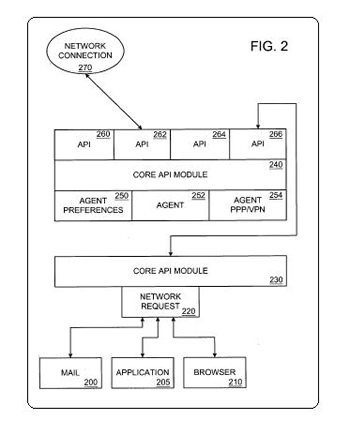
Patent FIG. 2 is a block diagram of one embodiment of an application programming interface (API) mechanism to support network connections based on contextual information. The example of FIG. 2 illustrates a two-part API mechanism to provide dynamically configurable connections on demand based on contextual information. Other mechanisms may also be provided using contextual information as described herein.
The API mechanism illustrated in FIG. 2 may provide dynamic network (e.g., PPP, VPN) connections based on contextual information to provide network connections that are appropriate for current system conditions. For example, network connections may not be allowed for applications checking for updates under certain conditions, or a VPN connection may be triggered only for private URLs and/or user-initiated electronic mail fetch operations.
In one embodiment, a software component that requests a network connection may make a call to network API 220. The software components may be, for example, an electronic mail application (mail 200) a Web browser (browser 210) or any other type of application (application 205). In one embodiment, network API 220 is a component of the Core Foundation framework or comparable system components (e.g., Sockets in a Windows.RTM. operating system environment), which are generally referred to herein as core API module 230. Core API module 230 may include other APIs or agents to provide additional functionality.
In one embodiment, a function call to network API 220 may include contextual information that may be used to determine characteristics of the network access in order to be used. For example, mail 200 may indicate whether the network connection is to be used for a background mail fetch or for a user initiated mail fetch. As another example, browser 210 may indicate whether a URL is entered or clicked by a user, or whether the URL is presented as part of an automatic refresh of a page. Other contextual information may also be provided by mail 200, application 205 and/or browser 210.
In one embodiment, core API module 230 interacts with system module 240 to access network connection 270. In one embodiment system module 240 may include multiple APIs (e.g., 260, 262, 264, 266) to interact with other system components and modules to provide desired functionality. In one embodiment, system module 240 may include agent preferences 150, agent 252 and PPP/VPN agent 254 as well as additional and/or different agents and related components.
In on embodiment, system module 240 includes functionality to analyze the contextual information received from core API module 230 to determine appropriate characteristics for the network connection to be used. For example, if a VPN connection is to be used to fetch e-mail, the fetch operation may only be performed for user initiated mail fetch operations. If a LAN connection is to be used to fetch e-mail, the fetch operation may be used for background as well as user initiated fetch operations. As another example, if a computer being used is not connected to a "home" network, a PPP connection may be used for public URLs and a VPN connection may be used for private URLs. When the computer is connected to the home network, both public and private URLs may be available via the LAN connection.
Notice
Macsimum News presents only a brief summary of patents with associated graphic(s) for journalistic news purposes as each such patent application and/or grant is revealed by the U.S. Patent & Trade Office. Readers are cautioned that the full text of any patent applications and/or grants should be read in its entirety for further details. See patent [url=http://appft1.uspto.gov/netacgi/nph-Parser?Sect1=PTO2&Sect2=HITOFF&p=1&u=%2Fnetahtml%2FPTO%2Fsearch-bool.html&r=1&f=G&l=50&co1=AND&d=PG01&s1=%22Apple+Computer%22&OS="Apple+Computer"&RS="Apple+Computer"]20060080673[/url]
Inventors listed on the patent were [url=http://darwinsource.opendarwin.org/10.3/configd-84/SystemConfiguration.fproj/ppp.c]Christophe Allie[/url] (see modification history listing) and [url=http://www.kame.net/dev/query-pr.cgi?pr=868]Howard Ridenour[/url] (See Originator).
Neo's notes
Interesting to note that if you follow the Howard Ridenour link above, He's listed as an Apple employee who was working on the KAME Project. [url=http://www.ipv6style.jp/en/special/kame/20051121/index.shtml]On IPv6style's[/url] special report on the conclusion of the KAME Project, they state that "Also Mac OS X is based on FreeBSD, which adopted the KAME code. If you would like to try out the KAME code, you can use Mac OS X."
On the [url=http://www.wide.ad.jp/news/press/20051107-KAME-e.html]WIDE[/url] (Widely Integrated Distributed Environment) Project's site, the following was presented:
Having achieved its objectives, the WIDE Project has concluded the activities of the KAME Project and is now concentrating on the strategic repositioning of the project members to focus on strategic research and development activities to further enhance IPv6 technologies and development applications for new areas. A particular focus is to be placed on practical and integrated research and development into network architecture, operating systems and middle ware and applications for areas including mobile ad hoc networking, sensor networking and architecture for end user security to contribute towards the development of further enhanced and advanced IPv6 technologies.
So, it's very interesting to note that Apple is a member of this project, as noted with Howard Ridenour's involvement (as an Apple employee). Other members in this distinguished group include ALAXALA Networks Corporation, Fujitsu Limited, Hitachi, Ltd., Internet Initiative Japan Inc., Keio University, NEC Corporation, The University of Tokyo, Toshiba Corporation and the Yokogawa Electric Corporation.
So if you're a super geek, then you may want to check out the Wide Project to see what it could be bringing to MacOS X in the future.
neo@macsimumnews.com










