The invention overcomes the above-identified problems associated with known classification systems by providing a method and apparatus for hierarchically clustering files and suitably labeling the resulting clusters. In one embodiment of the invention, this is achieved by exploiting a latent semantic analysis (LSA) paradigm, which has proven effective in query-based information retrieval, word clustering, document/topic clustering, large vocabulary language modeling, and semantic inference for voice command and control. More information on latent semantic analysis can be found in the article, "Exploiting Latent Semantic Information in Statistical Language Modeling", by J. R. Bellegarda, Proc. IEEE, Vol. 88, No. 8, pp. 1279-1296, August 2000, hereby incorporated by reference.
In accordance with the invention, the above-mentioned objectives are achieved by incorporation of a semantic view option within the graphical user interface. When invoked, this view employs a clustering and labeling algorithm that results in the creation of semantic hierarchy of all user-generated documents based on document content. Thus, the user is able to navigate among documents based on their content, rather than some other organizational structure.
Patent application excerpts
To facilitate an understanding of the principles and features of the invention, it is explained hereinafter with reference to its implementation in an illustrative embodiment. In particular, an example is provided in which text documents are analyzed and clustered on the basis of their word content. It will be appreciated, however, that the present invention can find utility in a variety of applications to various types of data files, as will become apparent from an understanding of the principles that underscore the invention.
[A] Computer typically includes an operating system (OS), which controls the allocation and usage of the hardware resources such as memory, central processing unit time, disk space, and peripheral devices. The operating system includes a user interface that is presented on the display device to enable the user to interact with the functionality of the computer. If the user interface is a graphical user interface (GUI), the operating system controls the ability to generate windows and other graphics on the computer's display device. For example, the operating system may provide a number of windows to be displayed on the display device 104 associated with each of the programs running in the computer's RAM 118. Depending upon the operating system, these windows may be displayed in a variety of manners, in accordance with themes associated with the operating system and particular desired display effects associated with the operating system.
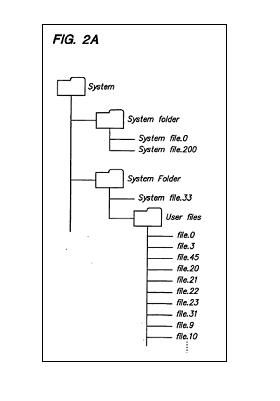
Another component of the operating system is the file system, which controls access to and organizes the files stored in the computer system, such as the local storage disk and/or remote storage media. The user interface provides a capability for a user to view the contents of the file system. For example, a graphical user interface may provide a hierarchical display of files and folders, or directories, as shown in Fig. 2A. The GUI can also provide other view options, such as by list or icon. These types of views typically correspond to a structural organization designed by the user. As discussed above, these known methods of viewing/navigating file system documents can become cumbersome to the user as the number of files increases.
A file system using a clustering and labeling algorithm
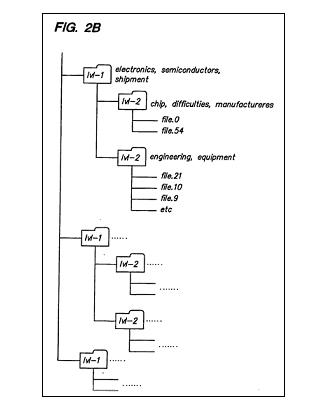
Accordingly, the invention provides a semantic view option that allows a user to view documents by, for example, the content of the file. This allows the user a choice of, for example, icons, list, file system columns, or semantic hierarchy. As shown in the hierarchical display of Fig. 2B [below], the user files are displayed in an hierarchical format based on the content of the documents. This is achieved, according to one embodiment of the invention, by employing a clustering and labeling algorithm that classifies text files based on the word content of the files. In the context of the present invention, the term "text file" is not limited to "pure" text files, e.g. those generated with a text editor program. Rather, it includes any type of file containing textual content that can be retrieved through a suitable text extraction or file translation process, such as files in PDF format, word processor files, and even image files containing text that can be discerned through optical character recognition or the like.
In addition to clustering and labeling text files based on semantic similarities within their content, the invention can cluster or organize non-text files in accordance with more traditional methods of clustering based on metadata. For example, graphic files can be organized under a label of "pictures" or they can be further organized based on information provided by the user during creation of the file, using rule-based clustering.
Clustering of the files can be initiated upon selection of a "semantic view" option within the GUI, and/or run periodically in the background. Once the initial analysis of the documents is performed to derive a taxonomy, re-evaluation of the collection is not necessary every time the user adds a document. As a result newly added documents can be classified against the existing taxonomy, and only if the "fit" is outside acceptable parameters is further evaluation and re-classification of the corpus of documents required. However, if preferable, the evaluation and clustering process can be performed upon creation of a new file, or periodically in the background, for example, when the CPU 112 is not in high use.
Three principle stages
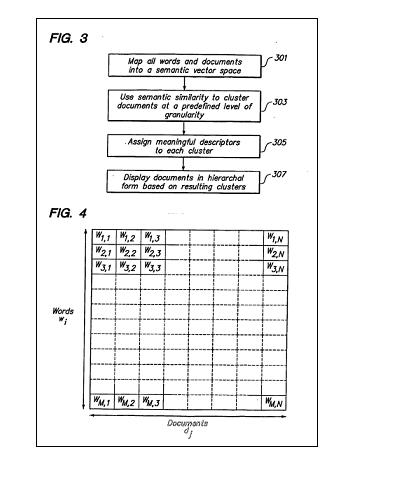
The clustering and labeling algorithm for text files comprises three principal stages: (i) mapping all words and documents into an appropriate semantic vector space; (ii) using semantic similarity to cluster the documents at predetermined levels of granularity; and (iii) assigning a meaningful descriptor to each resulting cluster in the space. These three stages are represented in Figure 3 as steps 301, 303 and 305, respectively. Once the documents have been clustered and labeled according to this process, they are displayed to the user, at step 307, in a manner that is based on the resulting clusters, as represented in Figure 2B.
Various techniques can be employed to accomplish these tasks. For textual documents, a language model is employed to identify the underlying semantics of the files. In a preferred embodiment of the invention, the statistical model provided by the LSA paradigm is used to implement all three of these stages. In general, scattered instances of word-document correlation are mapped into a parsimonious semantic space during the first stage by means of a dimensionality reduction technique provided by LSA. The second stage utilizes LSA document-to-document comparison capabilities to evaluate all potential clusters. LSA word-document comparison capabilities are used in the final stage to determine the words that are most appropriate for each cluster.
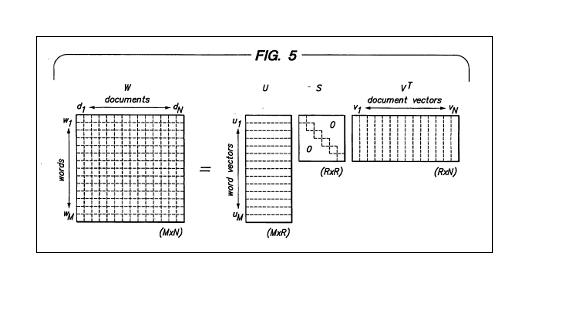
Patent application FIG. 4 [Above] illustrates a matrix that is constructed from a set of text documents, and FIG. 5 depicts the singular valued decomposition of the matrix.
The presently disclosed embodiments are, therefore, considered in all respects to be illustrative and not restrictive. The scope of the invention is indicated by the appended claims, rather than the foregoing description, and all changes that come within the meaning and range of equivalents thereof are intended to be embraced therein.
WHAT IS CLAIMED IS:
1) A method of displaying files within a file system to a user in a semantic hierarchy, the method comprising the steps of: mapping the files into a semantic vector space; clustering the files within said space; and displaying the files in a hierarchical format based on the resulting clusters.
2) The method according to claim 1, wherein the step of clustering the files is performed as a background routine during the operation of a computer associated with said file system.
3) The method according to claim 2, wherein the step of clustering the files is performed in response to the creation of a new file within the file system.
4) The method according to claim 1, wherein said files are text documents and said mapping is conducted on the basis of a language model.
5) The method according to claim 4, wherein said mapping step comprises the steps of constructing a matrix which associates each word in the documents with a vector and associates each document with a vector.
6) The method of claim 5, further including the step of decomposing said matrix to define the words and documents as vectors in a continuous vector space.
7) The method of claim 5, wherein said clustering is performed by identifying documents whose vectors are within a threshold distance of one another.
8) The method of claim 7, further including the step of defining multiple threshold values and clustering said documents in accordance with said multiple threshold values to thereby establish plural levels of clusters.
9) The method of claim 5 further including the step of automatically labeling the clusters.
10) The method of claim 9 wherein said labeling comprises selecting representative words based on the closeness of their vectors to the document vectors in a cluster.
11) A graphical user interface configured to display files in a virtual file system with a semantic hierarchy.
12) The graphical user interface according to claim 11, wherein the semantic hierarchy is based on clustering of files based on semantic similarities.
13) The graphical user interface according to claim 12, wherein clustering of the files is initiated by user selection.
14) The graphical user interface according to claim 12, wherein clustering of the files is initiated upon creation of a new file in the file system.
15) The graphical user interface according to claim 12, wherein text files are clustered utilizing a language model and non-text files are clustered utilizing rule-based techniques.
16) The graphical user interface according to claim 15, wherein said language model comprises the LSA paradigm.
17) Computer readable media having stored therein computer executable code for analyzing files in a file system to determine similarities in data pertaining to their content, and displaying files in hierarchical format based on determined similarities between the files.
18) The computer-readable media of claim 17 wherein said files are text documents, and the similarities are based upon the word content of the files.
19) The computer-readable media of claim 18 wherein said similarities are determined in accordance with a language model, and the files are clustered in accordance with said model.
20) The computer-readable media of claim 19, wherein said language model comprises the LSA paradigm.
21) The computer-readable media of claim 19, wherein said computer-executable code performs the steps of constructing a matrix which associates each word in the documents with a vector and associates each document with vector.
22) The computer-readable media of claim 21, wherein said computer-executable code further performs step of decomposing said matrix to define the words and documents as vectors in a continuous vector space.
23) The computer-readable media of claim 22, wherein said computer-executable code performs clustering by identifying documents whose vectors are within a threshold distance of one another.
24) The computer-readable media of claim 23, wherein said computer-executable code further performs step of clustering said documents in accordance with multiple threshold values to thereby establish plural levels of clusters.
25) The computer-readable media of claim 19, wherein said computer-executable code performs step of automatically labeling the clusters.
26) The computer-readable media of claim 25, wherein said labeling comprises selecting representative words based on the closeness of their vectors to the document vectors in a cluster.
27) The computer readable media according to claim 16, wherein the computer executable code performs the following steps: clustering text files within the file system using semantic similarities; clustering non-text files within the files system using rule-based techniques; labeling the resulting clusters; and displaying the files in a hierarchical format based on the resulting clusters and labels.
28) A computer system, comprising: a file system storing files; a display device; and a user interface which displays representations of files stored in said file system in the form of a semantic hierarchy that is based upon the content of said files.
29) The computer system of claim 28 further including a processor for analyzing the content of files stored in said file system to map said files into a semantic vector space and cluster the files within said space, and wherein said user interface displays said files in accordance with said clustering.
30) The computer system of claim 29 wherein said files are text documents and said processor maps said files on the basis of a language model.
31) The computer system of claim 30 wherein said processor constructs a matrix which associates each word in the documents with a vector and associates each document with a vector.
32) The computer system of claim 31 wherein said processor further decomposes said matrix to define the words and documents as vectors in a continuous vector space.
33) The computer system of claim 31, wherein said processor clusters the files by identifying documents whose vectors are within a threshold distance of one another.
34) The computer system of claim 33, wherein said processor clusters said files in accordance with multiple threshold values to thereby establish plural levels of clusters.
35) The computer system of claim 31, wherein said processor automatically labels the clusters.
36) The computer system of claim 35 wherein said processor labels the clusters by selecting representative words based on the closeness of their vectors to the document vectors in a cluster.
Notice
Macsimum News presents only a brief summary of patents with associated graphic(s) for journalistic news purposes as each such patent application and/or grant is revealed by the U.S. Patent & Trade Office. Readers are cautioned that the full text of any patent applications and/or grants should be read in its entirety for further details.
The inventors of this patent are Jerome Bellegarda and Wayne Loofbourrow, both from the U.S..
{encode=neo@macsimumnews.com title=Email Neo}










