Background/related art
In recent years, a large number of devices, such as printers, have been brought to market bearing various logos indicating that the device meets some sort of energy saving standard. At the same time, an increasing number of these devise are being attached to computer networks to allow workgroups to utilize their services. In order for these devices to be able to perform their services on the network, they need to be able to respond to requests on the network. However, many of these devices enter a power-saving mode when they have not been used for a specified amount of time. In order to restore the device to a normal operating mode, a packet can be sent to the device that contains a specific bit sequence that will "wake up" the device. This packet is commonly referred to as a "magic packet" or "wakeup packet" and the technology as a whole is referred to as "wake-on-LAN."
Power-saving modes can become a problem because the device typically will not respond to a request when it is in power-saving mode, and clients typically do not know the bit sequence of the magic packet that will cause the device to turn on. Hence, if the device is in a power-saving mode, it will not answer a request for a service provided by the device on the network, and therefore will appear offline to clients on the network.
In many cases, the user must manually walk over to the device and press a button to wake it up, or they simply may not be able to use the device at all. Moreover, a user may not even know of the existence or availability of a device if it is in power-saving mode. When device are in power-saving mode, they do not broadcast their services on the network, and therefore may not show up in a list of available services. This is especially true if the device has been in power-saving mode for an extended amount of time.
Hence, what is needed is a method and an apparatus for allowing the device to enter into power-saving mode while still maintaining visibility and availability on the network.
Summary
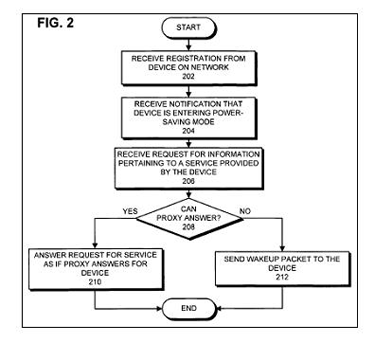
One embodiment of the present invention provides a system for implementing a sleep proxy. The system starts by receiving a request at the sleep proxy for information pertaining to a service provided by a device. In response to this request, the system determines if the device is a member of a list of devices for which the sleep proxy takes action. If so, the system determines if the sleep proxy can answer the request. If so, the sleep proxy sends a response to the request on behalf of the device.
In a variation on this embodiment, if the system cannot answer the request on behalf of the device, the system sends a wakeup packet to the device, wherein the wakeup packet caused the device to exit a power-saving mode so that the device can respond to the request directly.
In a variation on this embodiment, prior to receiving the request, the system receives a registration from the device, wherein the registration contains sufficient information to allow the sleep proxy to generate a wakeup packet that causes the device to wake up, and the list of requests for which the sleep proxy can answer. The system then adds the device to the list of devices for which the sleep proxy answers.
In a further variation, the registration additionally contains a lease expiration time, wherein upon reaching the lease expiration time, the sleep proxy cancels the device registration.
In yet a further variation, an internal time in the device wakes up the device so that the devices can renew its registration with the sleep proxy before the registration expires.
In a variation of this embodiment, the system receives a notification from the device that the device is entering a power-saving state. In response to this notification, the system configures the sleep proxy to answer for the device.
In a variation of this embodiment, the system receives a notification from the device that the device has exited a power-saving state. In response to this notification, the system configures the sleep proxy not to answer for the device.
In a variation of this embodiment, for fault-tolerance purposes, the system contains a second sleep proxy that mirrors the functionality of the sleep proxy.
In a further variation, the system waits a random period of time before answering for the device. This allows for duplicate answer suppression for multiple sleep proxies.
Patent Figure 2 presents a flowchart illustrating the process of a sleep proxy in accordance with an embodiment of the present invention.
Notice
Macsimum News presents only a brief summary of patents with associated graphic(s) for journalistic news purposes as each such patent application and/or grant is revealed by the U.S. Patent & Trade Office. Readers are cautioned that the full text of any patent applications and/or grants should be read in its entirety for further details.
Inventor: Stuart D. Cheshire
neo@macsimumnews.com










