In addition, Wikipedia goes on to present the fact that Meta Content Framework (MCF) was a specification of a format for structuring metadata information about web sites and other data. When the research project was discontinued, Guha left Apple for Netscape, where he adapted MCF to use XML and created the first version of the Resource Description Framework (RDF).
One application utilizing MCF was [url=http://en.wikipedia.org/wiki/HotSauce]HotSauce[/url] (code named Project X), also developed by Guha while at Apple. It generated a 3D visualization of a web site's table of contents, based on MCF descriptions. R.V. Guha now works at Google.
Abstract from Apple's WO patent
Techniques for sharing data with other application programs are disclosed. The techniques allow data sharing between application programs on a computer system. For instance, a second application program can access data provided by a first application program without needing the first application program t be operating or executing on the computer system. In one embodiment, an application operates to publish its data for external use by other application programs. The data is, for example, database data maintained by the application program. The data can be published for external use by producing a data communication file that contains at least a portion of data. In one implementation the data communication file contains the data being published for external use in a markup language representation. The techniques are particularly well suited for application programs that utilize databases to store media information pertaining to media items. The media information can include properties of the media items as well as links to storage locations for corresponding media content files that store the media content. The media content is, for example, one or more of audio, images or video.
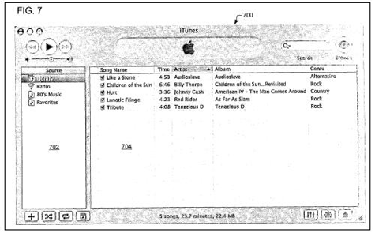
Patent Figure 7 is a screen shot of a user interface from a representation audio-based application program. The representative audio-based application program in this example is iTunes from Apple Computer Inc.
The user interface includes a source pane and a media item list pane. The source pane indicates the selection of the "Library" source for media items. The media item list pane displays a list of those media items (e.g., audio items, namely songs) available in the library. As illustrated in Figure 7, the list of songs in the media item list pane includes five songs, and provides media item information (Song Name, Time, Artist, Album and Genre) for each of the songs. Hence iTunes would maintain its own private database with the list of media items and the media item information therefore. Additionally, according to the invention, iTunes would, as discussed above, produce a public representation of the private database for access by other applications.
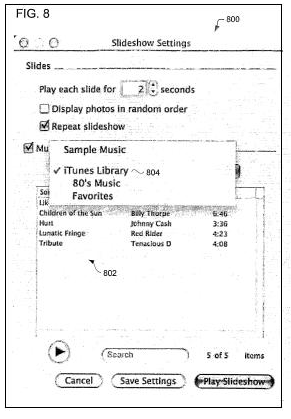
Patent Figure 8 is a screen shot of a user interface from a representative image-based application program. The representative image-based application in this example is iPhoto from Apple Computer Inc. A slideshow of images (e.g., photos) are able to be arranged and then subsequently played for viewers. Here, the user interface allows the users to set a play duration for each slide as well as to add music to the slideshow. However, iPhoto does not itself manage music content, but iTunes does. When both these program reside on the same computer, they can share [all of their] media databases using the inventive techniques, discussed above. Here, the user interface presented within the iPhoto application contains a list of selectable music songs (media items). This list of songs associated with an iTunes Library given the selection of a sample music source. The list has five songs and the media information for each includes Song, Name, Artist and Time. The list of songs thus is created using the public representation of the private (iTunes) database of iTunes, which is a different application. Note that the list of songs shown in FIG. 800 as presented by the iPhoto application resembles the list of the songs in the media item list pane shown in FIG 7 as presented by the iTunes application.
Although much of the above discussion pertains to a single computer system having multiple applications, it should be understood that the invention can equally apply to a system of computers. For example, with the inter-application data communication system 400, the application A 401 can be executed on a second computer. In general, the application desirous of inter-application data communication needs to agree to a location for the published database data. Still further, the published database data need not reside on the same machines as any of the applications.
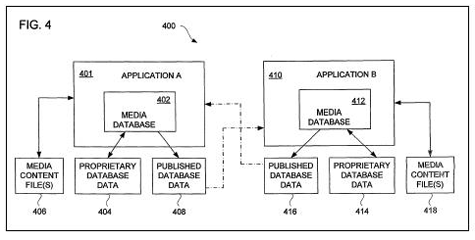
Patent Figure 4 is a block diagram of an inter-application data communication system according to one embodiment of the invention.
Advantages
The advantages of the invention are numerous. Different embodiments or implementations may yield one or more of the following advantages. One advantage of the invention is that the database data can be seamlessly shared between application programs. Another advantage of the invention is that a second application program can access a first application's database data and present a user interface that resembles a user interface that is used by the first application program. Still another advantage of the invention is that the application program that originated the database data need not be executing or running in order for another application program to gain access to the database being shared.
Notice
Macsimum News presents only a brief summary of patents with associated graphic(s) for journalistic news purposes as each such patent application and/or grant is revealed by the U.S. Patent & Trade Office. Readers are cautioned that the full text of any patent applications and/or grants should be read in its entirety for further details.
Neo's Notes
Even though Wikipedia's page on HotSauce states that "The project was discontinued along with MCF shortly after Steve Jobs' return to the company in 1997," you have to wonder how accurate a statement that really is in light of Apple's [url=http://www.apple.com/macosx/features/spotlight/]Spotlight[/url]. One thing is for sure, Apple has been a leader in the development of RDF and/or RDF-like technologies and their leadership is now evident in how they've seamlessly integrated Spotlight into OS X. In contrast, Microsoft is still trying to figure out how to copy the technology into their upcoming OS now dubbed Vista, which has been endlessly delayed.
Lastly, today's patent on data sharing could be very interesting in context with another recent Apple patent reported on by Macsimum titled [url=http://www.macsimumnews.com/index.php/archive/apple_eu_patent_suggests_ichat_av_to_add_pro_white_boarding]"Apple EU patent suggests iChat AV to add pro white boarding,"[/url] along with our February report titled [url=http://www.macsimumnews.com/index.php/archive/apple_ajax_and_share_with_mac_for_small_business/]"Apple, AJAX and 'Share with .Mac' for small business."[/url]
neo@macsimumnews.com
Other recent patents that may be related
[url=http://www.macsimumnews.com/index.php/archive/part_1_apple_files_eu_patent_for_peer_to_peer_content_sharing/]"Apple files EU patent for peer-to-peer content sharing"[/url]
[url=http://www.macsimumnews.com/index.php/archive/apple_files_patent_for_method_system_for_sharing_info_about_media_items/]"Apple files patent for method, system for sharing info about media items"[/url]










