Background/related art
The explosive growth of broadband technology and network infrastructure, coupled with continually decreasing prices, has lead to an increasing number of computer networks in homes and small businesses. Along with this small-office/home-office network revolution come the daunting task of configuring and administering these networks. Plug-and-play network protocols, such as Apple Computer Inc.'s Rendezvous, have been developed to simplify administration tasks. Within Rendezvous, devices such as printers, scanners, and network attached storage, automatically configure themselves and advertise their services upon being connected to the network. Computer systems on the network add resource records for these devices to their local cache upon receiving the advertisement, thus maintaining a list of available services on the network.
Along with benefits of maintaining a local cache come problems. Computer systems on the network must continually update their cache records to maintain an accurate list of available services. Traditionally, computer systems have done this by querying the services and waiting for a response. If a response is not received within a specified amount of time, or after a specified amount of tries, the record pertaining to the service or associated device is deleted from the cache. Frequently polling services (and related devices) in this way provides a more accurate list of services, but can dramatically increase network traffic.
One problem with caching resource records arises from the stale data. A device may be removed from the network in a manner that does not allow it to report the unavailability of its services. Power failures, improper shutdowns, and disconnected network cables are just a few examples of common occurrences that can cause invalid cache records. Often, users unsuccessfully try to use a service because a corresponding locally cached record fro the service is invalid, which cause the service incorrectly to show up locally as being available. This can result in frustration to the user because the service still shows up as available in the local list. Moreover, even if some cache records are invalidated on some computer systems, the same invalid cache records may still be present on other computer systems on the network.
Hence, what is needed is a method and an apparatus for maintaining resource records in a cache without the limitations listed above.
Summary
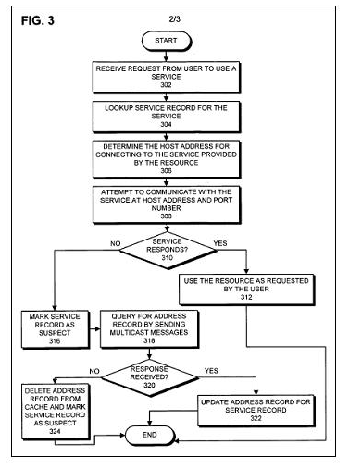
One embodiment of the present invention provides a system that facilitates validating a resource record in a cache. The system starts by retrieving the resource record at a client and attempting to use this information to establish communication with the corresponding service. If the attempt to establish communication is unsuccessful, then this suggests that the data in the resource record may be incorrect, so a query for that resource record is issued on the network. If a response is received containing different resource record data, then the cache is updated with new data, and the attempt to establish communication is repeated using the new information. If, after sending the query one, two, three, or more times, as appropriate, no response is received, then this indicates that the resource record is no longer valid, and it is deleted from the cache. In this way the stale data is deleted more promptly that it would be if the decision were made solely base on the time-to-live originally attached to that data.
When the record is deleted from the cache, this technique may then be applied recursively to call into question any records that refer to the now-deleted record. To take an example from the domain name system, if the now-deleted record were an address record, then any other records (e.g. SRV, PTR, CNAME, etc.) containing the name of this address record on their right-hand side are similarly suspect, and should be similarly updated or deleted as appropriate. In the case of Apple's Rendezvous [Bonjour], the response from the device is a multicast response, thereby allowing other clients to update corresponding resource records in their local caches without querying the device, and thus saving network bandwidth.
In a variation of this embodiment, prior to invalidating the resource record, the system issues a second query for the resource record and waits for a response to the second query from the device. If the response to the second query is not received in a pre-determined amount of time, the system invalidates the resource record.
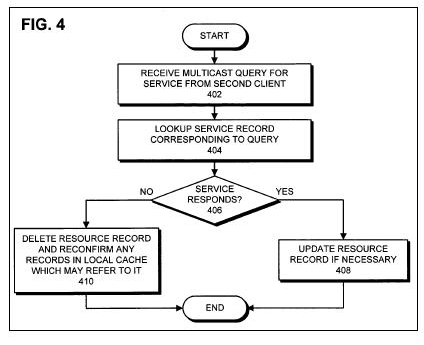
In a variation of this embodiment, the system receives a message from a second client querying fro a second resource record. Upon receiving the query, the system locates a second resource record and waits for a multicast response to the multicast message. If the multicast response to the multicast message is not received in the pre-determined amount of time, the system invalidates the second resource record.
In a variation on this embodiment, invalidating the resource record also involves invalidating a child record of the resource record.
In a variation on this embodiment, if the response to the query is not received in a pre-determined amount of time, the system retrieves a parent record of the resource at the client and multicasts a query for the parent record. The system then waits for a response to the query from the device, and if the response to the query is not received in a pre-determined amount of time, the system invalidates the parent record.
In a variation on this embodiment, if the response to the query is not received in a pre-determined amount of time, the system retrieves a parent record of that resource record at the client and multicasts a query for the parent record. The system then receives a response to the query from the device, and updates the resource recode with the information included in the response.
In a further variation, the system updates the parent record with the information receive in the response.
In a variation on this embodiment, the system is invoked to validate resource records in the cache at a pre-specified time interval.
Patent figures
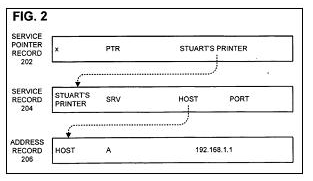
Patent Figure 2 illustrates cached resource records in accordance with an embodiment of the present invention.
Patent Figure 3 presents a flowchart illustrating the process of updating a resource record in a cache in accordance with an embodiment of the present invention.
Patent Figure 4 presents a flowchart illustrating the process of updating a resource record in a cache in response to a query in accordance with an embodiment of the present invention.
Notice
Macsimum News presents only a brief summary of patents with associated graphic(s) for journalistic news purposes as each such patent application and/or grant is revealed by the U.S. Patent & Trade Office. Readers are cautioned that the full text of any patent applications and/or grants should be read in its entirety for further details.
Inventor: Stuart D. Cheshire
neo@macsimumnews.com










