Background
Databases are used to store data in a manner that facilitates subsequent use of the data. Typically, a database includes several tables containing one or more records. A record in a table stored in the database can hold information about a subject or item in its various fields.
To allow a user to more easily access and manage data stored in databases, database programs have been developed. Database programs, among other things, often provide a user interface, which allows the user to conveniently interact with the database program in order to perform various operations on the data stored in the database. The interface provided by the database program is typically a graphical user interface which allows the user to conveniently interact with the database program and, in turn, with the database. The user may interact with the graphical user interface to, for example, view the data in various ways. The visual representations provided to the user can include, for example, a browse mode. The browse mode allows records to be viewed, changed, sorted, deleted, or added.
As noted above, a database program allows users to conveniently access data stored in a local database. It should be noted that a database program (or product) could also be provided as database server (or host), which allows a client (or a guest) to access data in a database, which is stored in a remote location with respect to the client. Generally, a first database program can, for example, be connected to a second database program over a computer network. In any case, one database program can act as a "client" (or guest) and establish a connection to the other database program which acts as "server" (or host) to a database. The client database program can, in turn, provide the end-user (e.g., a human, or application program) with access to data, which is stored remotely.
Conventional database server programs (or products), however, can be configured only to grant access to a database based on a set of database accounts, which are typically defined by a database administrator, or alternatively grant access based on a set of operating system accounts which are typically defined by a system administrator. These operating system accounts are typically a set of general purpose accounts associated with different category of access privilege (e.g., "admin," "manager," "data-entry-only").
These different categories of access privileges are typically assigned to several different users. For example, several different individuals may be assigned the access level "manager." This approach, however, does not allow a particular user to be identified when an external account is used, and thus may not adequately support a secure environment and/or allow monitoring (or logging) activities initiated using external accounts. In addition, access privileges cannot be easily modified (or updated) when general categories of access privileges are used (because access privilege is not defined per individual users). For example, if a particular manager leaves, the "manager" access level should be changed to security reasons. As a result, several other managers may have to be assigned a new access-level.
Moreover, conventional techniques do not allow configuring a server database product (or program) such that both database and operating system accounts can be used together to control access to a database. In other words, conventional database server products control access to a database either entirely based on non-database accounts (e.g. operating system accounts), or entirely based on a set of identifiers (e.g., access keys), which are typically maintained and administered separately from the non-database accounts.
As database products are more commonly used to access databases in corporate environments, the need for integration of databases with corporate computing systems becomes more prevalent. Accordingly, improved techniques for controlling access to databases are needed.
Summary
Broadly speaking, the invention pertains to techniques for controlling access to a database.
In accordance with one aspect of the invention, sets of database "internal" and "external" (or non-database) access-privileges are defined for a database. An "external" database component can, for example, be any component that resides outside a database system, program, or product that is used as interface to access a database. It will be appreciated that corporate accounts which are generally used in many corporate environments (e.g., operating system accounts) can be defined as database "external" accounts in accordance with one embodiment of the invention. In general, the database external access-privileges are used in conjunction with a set of complementary database "internal" access privileges defined for database internal accounts. In addition, sets of database "internal" and "external" access-privileges are can be combined to generate an integrated access-privilege set which can be used as a single source to authorize access to a database regardless of whether database internal or external accounts are used to access the database. As such, the invention can be used to seamlessly integrate databases with various non-database entities (e.g., corporate computing systems). It should also be noted that non-database accounts may be authenticated externally, but access can be authorized using a database component (e.g., a server-side database component). Hence, databases can be integrated with various non-database entities, while authentication of non-database accounts is still performed by database external entities that are generally more preferred to authenticate their own accounts.
As will be described below, the invention can be implemented to control access with respect to both database internal and external accounts, which can be used to seek access to the database. Moreover, access to the database can be controlled using the same authentication information (e.g., username and password of an operating system account) regardless of whether the database is internally or externally accessed. This can be achieved by defining and using database "internal" and "external" access-privileges in a manner that allows combining them together and using them as an integrated access-privilege set arranged in accordance with assigned priority of authorized access. As a result, database internal and external access privileges may be conveniently defined and maintained in a central location, by a single entity that does not have to be a database administrator (e.g., a system or server administrator). Yet, a database administrator can still access the database using a database internal account regardless of which server or external ("non-database") authenticator has been chosen by the non-database administrator (e.g., a system or server administrator) to authenticate database users.
The invention can be implemented in numerous ways, including as a method, an apparatus, a computer readable medium, and a database products, program, or system. Several embodiments of the invention are discussed below.
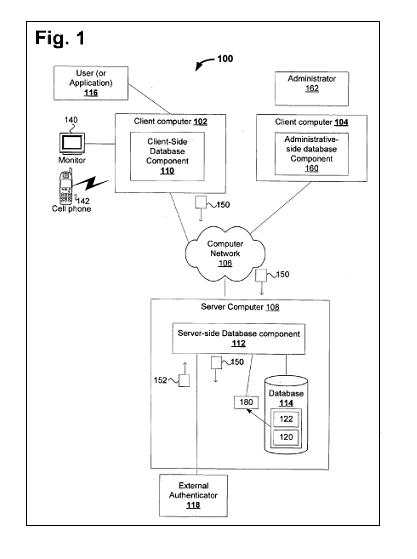
Patent application FIG. 1 depicts a computing environment 100 in accordance with embodiment of the invention.
Notice
Macsimum News presents only a brief summary of patents with associated graphic(s) for journalistic news purposes as each such patent application and/or grant is revealed by the U.S. Patent & Trade Office. Readers are cautioned that the full text of any patent applications and/or grants should be read in its entirety for further details.
The inventors listed on patent application [url=http://appft1.uspto.gov/netacgi/nph-Parser?Sect1=PTO2&Sect2=HITOFF&p=1&u=%2Fnetahtml%2FPTO%2Fsearch-bool.html&r=14&f=G&l=50&co1=AND&d=PG01&s1=%22apple+computer%22&OS="apple+computer"&RS="apple+computer"]20060173810[/url] are Erwin Hom and Clay Maeckel.
{encode=neo@macsimumnews.com title=Email Neo}










