Background of the invention
In a computer network in which a plurality of clients communicate with one or more servers, a protocol is necessary to establish the rules by which the information is transmitted to effect such communication. Generally, the information is sent from the server in successive packets of information, with each of the packets transversing their own paths through the network, until such time as the packets are reassembled at the destination client. To establish the communication, each packet contains, in addition to a data segment of the total information to be sent, the source address of the server in the network and the destination address of the client in the network.
A commonly used protocol used to establish these connections is the Transmission Control Protocol ("TCP"). TCP is used along with the Internet Protocol ("IP") to send data in the form of message units between computers over the Internet. While IP takes care of handling the actual delivery of the data, TCP takes care of keeping track of the packets that a message is divided into for efficient routing through the Internet.
For example, when an HTML file is sent from a web server, the TCP program layer in that server divides the file into one or more packets, numbers the packets, and then forwards them individually to the IP program layer. Although each packet has the same destination IP address, each packet may get routed differently through the network. At the client, TCP reassembles the individual packets and waits until they have arrived to display the re-assembled HTML file.
TCP is also known as a connection-oriented protocol, which means that a connection is established and maintained until such time as the message or messages to be exchanged by the application programs at each end of the connection have been exchanged. TCP is responsible for ensuring that a message is divided into the packets that IP manages and for reassembling the packets back into the complete message at the other end.
Another protocol to transmit information is the User Datagram Protocol ("UDP"). UDP is a communications method that offers a limited amount of service when messages are exchanged between computers in a network that uses IP. UDP is an alternative to TCP and, together with IP, is sometimes referred to as UDP/IP. Like TCP, UDP uses the IP to actually get a data unit, or datagram, from one computer to another.
Unlike TCP, however, UDP does not provide the service of dividing a message into packets or datagrams, and reassembling them at the other end. Specifically, UDP does not provide sequencing of the packets that the data arrives in. Accordingly, the application program that uses UDP must be able to ascertain that the entire message has arrived and is in the right order. Network applications that want to save processing time because they have very small data units to exchange (and therefore very little message reassembling to do) may usually use UDP instead of TCP. UDP does provide two services not provided by the IP layer. It provides a port number to help distinguish different user requests and, optionally, a checksum capability to verify that the data arrived intact.
For streaming applications over a computer network, both UDP and TCP have significant disadvantages and limitations. For example, since TCP requires that all packets are received prior to reassembly at the client, any missing packets could cause the streaming application running at the client to be paused due to the lack of data. UDP also requires that all of the packets are received and also received in the right order, since there is no sequencing of the packets. For a large number of packets in a streaming application, the packets may arrive out of order, resulting in degradation of the output of the streaming application.
Other features of TCP further disadvantageously limit the ability to deliver packets for streaming applications in a timely manner. For example, TCP requires that each packet sent in the stream must be received and each packet delivered to the client in the order sent. This requirement of TCP is especially limiting and disadvantageous for a streaming application. If the server sends four sequential packets, and packet 1 is lost, the client running the streaming application cannot receive the remaining three packets from the TCP protocol stack until it receives the first packet. If the client receives the first packet sufficiently late, all the previously received packets may be useless due to the tardy reception. In any event, the output of the streaming application will be degraded or possibly halted.
There is therefore needed a connectionless protocol which overcomes one or more disadvantages and limitations of the prior art herein above enumerated.
Summary of the invention
It is an object of the present invention to overcome one or more disadvantages and limitations of the prior art herein above enumerated.
It is an object of the present invention to provide a conectionless protocol which does not require receipt of all packets by the client, nor require receipt of packets in order of transmission.
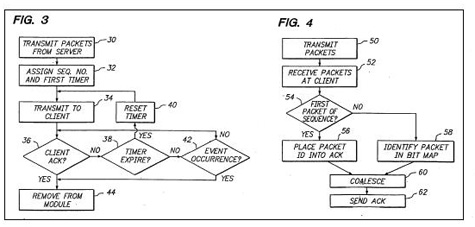
According to one aspect of the present invention, a method for real time transmission of information content between a network server and a network client comprises the steps of transmitting successive packets of the content from the server to a retransmit module, assigning at the retransmit module to each of the packets a sequence number and a first timer, transmitting further each of the packets from the retransmit module to the network client, transmitting from the network client to the retransmit module an acknowledgment for each of the packets received at the network client, retransmitting from the retransmit module any of the packets upon expiration of the first timer assigned thereto prior to an acknowledgment for the any one of the packets being received, and removing from the retransmit module any of the packets upon an event determination prior to an acknowledgement for such anyone of the packets being received.
In a second aspect of the present invention, a method for acknowledging receipt of packets sent from a network server to a network client comprises steps of transmitting successively packets from the server, receiving at the client several of the packets, placing into a coalesced acknowledgment an ID of a first one of the several of the packets received at the client, adding to the coalesced acknowledgment a bit map identifying selected other ones of the several of the packets received at the client, and transmitting to the server the coalesced acknowledgment.
Features of the present invention are flow control, congestion avoidance and packet recovery without any necessity for guaranteed or in order delivery. Flow control is achieved by limiting the amount of unacknowledged data to a given window size. When the window is full, further transmission is delayed until packets are acknowledge or expired. A slow start algorithm is also provided to adapt the rate of packet transmission to the client. Congestion is avoided by using the TCP exponential back off. Robust packet recovery is obtained by using [url=http://www.soi.wide.ad.jp/class/20020032/slides/11/36.html]Karn's algorithm[/url] for round trip estimation. The order of packet deliver is not required nor guaranteed. Acknowledgments are sent on a packet by packet basis. In another embodiment of the invention, acknowledgments may be coalesced.
Random patent figures
Patent application FIG. 3 is a flow chart useful to describe one method of the present invention and FIG. 4 is a flow chart useful to describe another method of the present invention.
Notice
Macsimum News presents only a brief summary of patents with associated graphic(s) for journalistic news purposes as each such patent application and/or grant is revealed by the U.S. Patent & Trade Office. Readers are cautioned that the full text of any patent applications and/or grants should be read in its entirety for further details.
The sole inventor listed in patent application [url=http://appft1.uspto.gov/netacgi/nph-Parser?Sect1=PTO2&Sect2=HITOFF&u=%2Fnetahtml%2FPTO%2Fsearch-adv.html&r=1&f=G&l=50&d=PG01&p=1&S1=20060155870&OS=20060155870&RS=20060155870]20060155870[/url] was Rusty Tucker.
neo@macsimumnews.com
Notes: 1) Another Karn's algorithm reference could be found [url=http://www.scit.wlv.ac.uk/rfc/rfc29xx/RFC2988.html]here[/url].
2) The delay in posting this report was due to Macsimum's holiday schedule.










